Friday, June 12, 2009

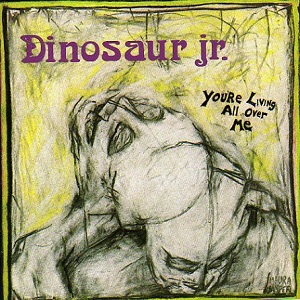
Dinosaur Jr - You're Living All Over Me (SST Records/1987)


I'm not the biggest fan of guitar solos. It could be that I'm just used to hearing bad ones, but few guitar solos can find that fine line between amateurish scale-following and masturbatory note-cramming. And yet, whenever I hear the guitar solo in “Kracked,” I can't help but smile. Could it be possible that J Mascis has the ability to find that line and shred all over it? Yes.

Even though this album is the very definition of “Alternative Music,” a term which I loathe, it rocks harder than any of the proper metal albums I own. Why? It has the balls to hold back, to restrain. It makes the moments when the band lets loose all the more powerful. “The Lung” takes it easy for the majority of the song, the guitars simply bending and twisting around the heavy rhythm sections. Even the solo is a pretty chill one. But then comes the ending stretch of the song that schizophrenically switches between it's original self, and itself sprinting on cocaine.

Now, You're Living All Over Me isn't just about the guitars, and Dinosaur Jr isn't just about Mascis, no matter how much he'd like to believe so. The drums and bass hold their own, providing a worthy canvas for Mascis to paint his sound on. Lou Barlow's bass playing is difficult to describe. It isn't show-stealingly funky, but he doesn't just fade into the background either. There's that fine line again. But he doesn't shred on the bass. Instead, he plays in waves, letting Mascis do his own thing while he holds the reigns on the tempo, slowing it down or speeding it up as he pleases.

As good as this album is, I wish it ended right after “In a Jar.” I realize that that would make this album no longer an album, but rather, a long EP, but “In a Jar” is a really good song to go out on, and the songs after it are pretty terrible. “Lose” doesn't feel like it's even trying to go anywhere, while “Poledo” lays it on a bit too thick with the experimentation. Both are boring.

I can't help but think that if Hendrix were alive today, he'd have more in common with bands like Dinosaur Jr and Sonic Youth than cockrockers like Dragonforce or someone equally shitty. Guitar oriented rock isn't just about the solos. It's about everything around it, the trip getting there, the rhythms behind it, the stuff that comes after. Endlessly sweeping arpeggios up and down the neck doesn't achieve much, especially because by then, you're just playing to yourself.

Wednesday, May 20, 2009

Bomb the Music Industry! - Scrambles (Quote Unquote/2009)


I've teared up reading books. I bawled a bit during movies. I even got choked up at the Season 2 finale of The Office (US). It's been a while, though, since I've felt a sadness harsh enough to tear about listening to music. But then, one day, I was walking through a park listening to the third track on Scrambles, “Fresh Attitude! Young Body!,” and I cried like a schoolgirl that just found out her dog has to be put down because it has rabies. Yeah, it was that bad.

It's a formula as old as formulas themselves, placing sad lyrics on top of happy music. But somehow Jeff Rosenstock and co. have found a way to make it new again. Scrambles is just seething with lyrics about how much being poor sucks, coke sucks, snobs suck, not to mention coming to terms his own immaturity. That being said, it's the most fun and refreshing punk album to come out since the last Bomb the Music Industry! album. What helps is that the music, much more than the lyrics themselves (with one song being the exception), realizes that it's better to find the fun and humor in everything rather than wallow in your own self-pity. “It Shits!!!” is all about how much “it shits that I only get to see you for an hour and a half every day/ and it really really shits that that hour and a half isn't really very good anyway.” Sad stuff, right? The synth and the stumbling drum machines seem to think otherwise. The instruments scream “Fun! Fun! Fun!” while the lyrics are sad sad sad, creating a swelling emotion that's consistent throughout the album.

Of course all of this talk about sad lyrics doesn't account for “Sort of Like Being Pumped,” an epic ballad about being able to enjoy something as simple as a sunset. I'll be honest I didn't like the demoed version of this that was leaked a year or so ago, but I guess that's why they're leaked demos and not the real deal. Good God, this song is brilliant. It's the kleenex tissue that wipes the tears from the rest of the album away. It's the warm home-cooked meal your mom made for you after a semester of eating ramen. It's the full bottle of Vicodin you get after you get four of your wisdom teeth pulled. It's also probably the best Bomb the Music Industry! album closer to date, which is saying a lot.

In saying this, I may be biased. Not only do I consider Bomb the Music Industry! as one of the best music acts around today, but I am also a New Yorker, and this album has it's roots placed firmly within the concrete landscape that is New York City. When Rosenstock sings about fare hikes and an umbrella filled New York, I can't help but “get it.” I understand that walking in the city when it rains is a bitch, that waiting 20 minutes for the train is a hassle. Obviously, when he makes any reference to a specific train line, my head replaces it with the Q train, but other than that, there's a connection with New Yorkers in this album that I don't know if any others can get. Their loss.

Go to the Quote Unquote Records website. Download the album. If you can, donate some money. You'll feel good.

Wednesday, May 6, 2009

Black Eyes - Black Eyes (Dischord/2003)


This self titled Black Eyes album is one of the few albums which I took a chance on and was pleasantly surprised. I knew they were on Dischord, but I had no idea what they sounded like. I decided to give them a shot without sampling them on the Internet somewhere, and ordered the album for cheap on Amazon. It was probably one of the best decisions I've ever made.

Black Eyes are made up of two drummers, two bassists (one of whom sings), and a guitarist/vocalist. It's an odd, risky, set up, but it works. The drummers work hand-in-hand providing a cacophony of a background for the bassists to do their groove dueling while the guitar screeches and whines all over the place. In the forefront are the vocalists singing/screeching about social issues, dealing head-on with rape, racism, and other things that make life so much fun. It's a difficult album to listen to at times, simply because of the combinations of the harsh subject matter of some of the songs and the unbelievable grooveablilty of them. One song in particular, “Deformative,” deals with the hardships of pedophilia from the eyes of the pedophile. It'd be a rough pill to swallow if it wasn't for the bitcchin' bass lines and the frenetic drums making the song so easy to dance to.

I wasn't very surprised when I found out Ian Mackaye produced the album. Firstly, it's a Dischord album. Secondly, it sounds like a Fugazi album, if Guy Piccotto was castrated and the entire rhythm section went crazy. In a good way, of course.

I can understand that this album is hard for some people to get, mainly due to guitarist/vocalist Daniel Martin-McCormick, but this guy makes the album. His shrill screams, especially when placed against Hugh McElroy's more conventional vocals, are a piercing call to attention at the things he's singing about. He doesn't really play notes on his guitar, but opts for hitting it with metal things creating some awesome distorted scratching noises. He brings life to the band's full-bodied rhythm section, never letting up on the insanity.

It's cautious, but never careful. It's forward thinking without being overly ambitious. It's also only thirty minutes long. Take a chance and listen to it.

Note: Dan Martin-McCormick and bassist Jacob Long are in a new band called Mi Ami. It's a different, slower vibe, but it's pretty sweet.

Thursday, April 30, 2009

In Defense of Pop Punk


I don't doubt that it could be nostalgia, but lately I've been reacquainting myself with the music I listened to in my Junior High School days, and loving it. I was a big fan of the pop punk that was on the radio in the late 90's and early 2000's, and I've come to realize that not all of it was terrible. A lot of it was good. In fact, some it was amazing.

This era of radio punk gets a lot of flak from fans of “real punk.” Many considered it a commercialized mockery of what punk music really is, only existent in order to make money for record labels and corporations. Boy bands with guitars. I was listening to an Ian Mackaye interview the other day, and the interviewer (I forget who it was. I found it on YouTube somewhere, so if you're that interested you can find it yourself) asked Ian what he thought about bands like The Offspring and Green Day. In true immovable Ian Mackaye fashion, he replied that he doesn't consider them punk at all. Now, I love Ian Mackaye. Fugazi isn't one of my favorite bands; it is my favorite band. I wholeheartedly believe that without him and Dischord Records, music, especially independent music, would not be where it is today. That being said, I disagree. Were bands like Sum 41 and Blink 182 so completely anti-establishment that they DIY'd everything? No. Did they suck from the teat of major labels in order to get some money? Probably. But does that really matter? These were just a some of kids who found out how to play a couple power chords and churned out some pretty sick songs. Their music got marketed to kids, and we ate that shit up like Skittles, leaving them with a good wad of cash. Good for them.

I've come to the conclusion that good music is good music, no matter what the reasons for its existence are. One of my favorite songs right now is New Found Glory's “My Friends Over You.” Holy shit this song is awesome. Simple chord progressions (like, two), catchy hooks, and a chorus that everyone in the room can sing along to and feel good. There is nothing wrong with that. Lyrically, it's something that the band's target audience, teenage boys, can relate to. It's a simple “bros before ho's” kind of anthem, and it works. More importantly, it's fun. If there's one thing I hate it's people raining on my parade, and rocking out to Bowling for Soup's “Girl all the Bad Guys Want” is my Thanksgiving.

Was all of it good? Of course not. I didn't like Simple Plan in seventh grade and I still don't like them. Good Charlotte I could do without (oddly enough, I kind of liked that song they did with Avenged Sevenfold), but I realized that I missed out on enjoying some of the later radio hits that came out during the tail end of this fad, simply because I was too embarrassed to admit I liked it. I'll admit that I used to be that self conscious. I remember pretending not to like Yellowcard's “Ocean Avenue.” Which is sad, BECAUSE THEY HAD A FUCKING ELECTRIC VIOLIN. HOW RAD IS THAT?

Thursday, April 23, 2009

The Arcade Fire - Neon Bible (2007/Merge)


I remember when this album came out. The album art was all over NYC, not to mention in big bright displays inside Virgin Megastores. If there was ever a time when independent music came into the mainstream (kind of an oxymoron, I know!), it was with the release of this album. And with good reason, too. Why?

It's awesome.

We could get into harsh debates about whether or not Neon Bible is better than Funeral, but why waste the time? This is good music we're dealing with here, I, for one, would rather spend my time listening to Neon Bible rather than arguing about it. There's just so much to listen to.

With a name like Neon Bible, it's hard not to draw religious themes from it, and it is very present. With lyrics like “dear God, I'm a good Christian man” and “working for the church while my family dies/ your little baby sister's gonna lose her mind” it's fairly obvious that this is an album dealing with dark reflections (hah!) of life through a religious lens. This is all well and good, and not to go unappreciated, but what I honestly love about the album is simply how loud it is. Much of this loudness is thanks to my good ol' friend, the pipe organ. I've spent many a Sunday at church admiring the thing, but never in my life would I think that it'd work in a rock setting. Nevertheless, they make it work. The obvious example of this being that big boom in the middle of “My Body is a Cage,” probably one of the best closing tracks I've heard. The pipe organ gets some help with the multitude of all the other instruments mixed in, too. Horns, violins, and Win Butler's own mandolin helps create the feeling of music exploding in your ears. It's all good.

Speaking of the mandolin, the album never loses it's folksy roots. It's not a folk album, by any means, but there's always a twang to it that sounds distinctly American. I know they're Canadian, but Butler was born in Texas. It's good to know that he still keeps his roots about.

Wednesday, April 8, 2009

Belle & Sebastian - Dear Catastrophe Waitress (2003/Rough Trade)


Good pop music usually comes with this funny feeling. It's a happy, fun, bouncy feeling that puts a smile on your face and a skip in your step. Soon after the music stops, though, the feeling goes away, the smile fades, and you've got to keep walking on your way through your humdrum life. It's a bit different when dealing with great pop music. Great pop music leaves you with something to think about after the smile fades, distracting you from your humdrum life, making it a bit more bearable. That's almost what it's like listening to Dear Catastrophe Waitress.

What makes this album so fun to listen to is its revelry in the baroque. Strings! Horns! Other stuff that I can't make out! It brings the music to a hilarious level, which Belle & Sebastian are very aware of. On the title track, Stuart Murdoch sings “I'm sorry if he hit you with a full can of coke/ it's no joke” while the orchestra in the back makes sounds akin to something that would be heard on a Merrie Melodies cartoon or something. The music doesn't really take any of the lyrics seriously, which is a good thing for a pop record. There's really only one slow track on the album, and one's enough.

Steven Mudoch's vocal delivery makes listening to the entire album a bit aggravating. His whispering vocals distance himself from the music. As the one of the main songwriters, he should be owning these songs like they were his own testicles, but instead, it sounds like someone's got them in a vice-grip and are willing to crush them at the sound of a wrong note. His vocals fit some of the songs on the album, but a song like“If You Find Yourself Caught In Love” could use some chutzpah behind it.

The most disappointing thing about the album is that none of the band members seem to realize that it's not 1960 anymore. Yeah, it's all well and good to craft well executed pop songs that sound like they're from back in the day, but give me something that I haven't heard before, something refreshing. It's perfectly fine on its own merits, but “fine” isn't good enough to progress the genre. “Fine” isn't good enough to mean anything. Now, does every band have to try to do something new with music? No, not really. But then again, not every band has to matter. I'm not sure if Belle & Sebastian does.

Wednesday, April 1, 2009

Les Savy Fav - Let's Stay Friends (2007/Frenchkiss)


“Art punk” is one of the dumbest “musical genres” I've ever heard. It's a ridiculous phrase that wouldn't exist if it weren't for music snobs that feel the need to label everything. A quick Wikipedia search tells me that it can refer to music made by kids who went to art school and liked Sonic Youth, or music that is done to sound sorta/kinda/maybe experimental. Silly, right? Unfortunately, as much disdain as I have toward the term, I can't help but think that Les Savy Fav do both with style.

Let's Stay Friends is their most accessible record to date. It hits the perfect balance and finds the perfect blend of noise, punk, dance, funk, and pop creating an album that only the deaf couldn't enjoy. Seth Jabour's guitar work is top-notch, creating captivating hook after captivating hook, especially on one of the album's best tracks, “Patty Lee.” Syd Butler's basslines are unceasingly fitting; sometimes groovy, sometimes thumping, always good. He works hand in hand with drummer Harrison Haynes, driving all the songs forward, or pulling back on the reigns when appropriate. On top of that, Tim Harrington is a master when it comes to thinking up quirky, but thoughtful, lyrics and he delivers them with gusto. “If you feel, my dear the end is near/ please do check your frontal hemisphere,” he sings on “The Year Before the Year 2000,” a song that's urging people to always party like it's 1999. It's all really fun stuff.

What's the problem, then?

It's own accessibility is its biggest flaw. By easing up on the noisy guitars that may have driven listeners away from previous albums, and Harrington singing instead of barking, there's a loss of intensity on the record. There aren't enough songs that make you want to pump your fist in the air and shout “Fuck yeah!,” and even the ones that do don't deliver hard enough. When Harrington finally lets go at the end of “The Lowest Bitter,” it's too little too late and the album's over. It's less punk, more art.

As far as the pacing goes, it ebbs and flows nicely. Just when you're tired of drums being beaten over your head, the album offers something spacier and more bass driven. And just when you get bored of that, the album offers ripping guitars. These guys know what they're doing. As their website says, they've been “missing out on cashing in for over a decade.” That's a long time to learn how to piece an album together, something most people overlook.

Despite the fact that they have enough indie-cred to start swimming in it Scrooge McDuck style, the overproduction that blankets the entire album is a problem. Sonically, it sounds like a band's first album on a major label. Yes, I am aware of how pretentious that sentence sounds, but it's true. There's a slick sheen over the album that detracts from the meager offerings of raw grit that we get. This is especially true when it comes to the drums. Take “Raging in the Plague Age,” for instance. The drums on that track should be bone rattling and gut wrenchingly powerful, but they get muted and muffled so instead they sit, comfortable in being nothing more than a metronome.

Even with its flaws, Lets Stay Friends is still an amazing album. I think I'd be happy using the phrase “art punk” if it referred to music that was as good as Les Savy Fav.

Wednesday, March 25, 2009

Wilco - Yankee Hotel Foxtrot (2002/Nonesuch)


People suck. Jeff Tweedy is more aware of this than most. Steeped in a puddle of Americana, Wilco's fourth album, Yankee Hotel Foxtrot, finds the lead songwriter trying to stop, and figure things out. He uses this album as a vehicle to question why people, especially himself, do the things that they do. In relationships, a term I am using very broadly, we cannot seem to stop hurting one another as well as ourselves. Why? We aren't given an answer. Instead, by the end of Yankee Hotel Foxtrot, we are left with a band, a man, an album, on that very same path of self destruction.

It's a path worth taking, though. The album opens with “I Am Trying to Break Your Heart,” a song that, on the surface, seems intentionally mean-spirited. Tweedy sings about purposefully inflicting the kind of emotional pain that only a singer/songwriter could deliver, and he comes off as some sort of drunken asshole. But then come the drums. The drums that are almost silent throughout the verses come in jarringly in between Tweedy's admittance of maliciousness, contradicting the cocky and self-assured attitude of the lyrics that came before. The rest of the “noisy” sounds serve the same purpose: audible shorthand for Tweedy's conscience. The same formula is used throughout the album. The songs that are bred from uncertainty are caked with experimentalism and noise. This explains the spacey production found on some of the songs, and the more blatant noises found on others. The problem is that only a few of these songs are as good as “I Am Trying to Break Your Heart.” Tweedy's droning voice on “Ashes of American Flags” fades into the rest of the ambient noises found on the track, and we are left with only the sharp guitar lines to jolt us awake. It's not a pleasant feeling.

The rest of the album picks up the slack, though. Wilco doesn't let us forget that this is the same band that made Summerteeth, and provides a good number of solid pop songs. Nothing on this album can get girls dancing on tables faster than “Heavy Metal Drummer” nor does “Pot Kettle Black” fail to break the tension built up from the multitude of the slower songs. These songs, while easy to listen to, do not break from the harsh theme of introspection of the album as a whole. “Jesus Etc.” is heartbreakingly apologetic, as is “I'm the Man Who Loves You.”

Ultimately, what makes this album so good is that it, like all other great albums, is not merely a collection of songs, but one cohesive unit. The songs seamlessly flow into one another, creating swelling emotions that climax at the end of “Poor Places,” but leave us in a wondering daze with “Reservations.” “I've got reservations/ about so many things/ but not about you,” he sings, and we could see this as a happy ending, but why then, are we left with about three minutes of ambient noise? Taking this time to put the dots together, and digest the album as a whole, it becomes clear. That line is just that. A line that's fed with the outcome of heartbreak nearby. And the path goes on. Not since my last cigarette has self-destruction felt this good.


PS. I haven't quite figured out if I wanted to do some sort of numerical counter for albums, so let's just call this one a 4/5.